
What Are the Odds of Winning the Lottery: Complete Guide

Did you know the odds of winning the US Powerball jackpot are a mind-boggling 1 in 292,201,338? Many people play the lottery in hopes of changing their lives overnight, yet few actually understand how the math behind the games truly works. Learning how lottery odds are calculated can give you a clear-eyed view of your chances and show why some strategies are smarter than others for any hopeful player.
Key Takeaways
| Point | Details |
|---|---|
| Understanding Odds | Lottery odds are based on mathematical combinations and probabilities, without influence from past results. |
| Comparison of Lotteries | Different lotteries have varying jackpot odds; understanding these can inform smarter choices about where to play. |
| Small Prize Potential | Smaller prize tiers offer significantly better odds compared to jackpots, making them a more realistic winning strategy. |
| Strategic Play | Employing techniques like lottery wheeling can help maximize winning chances for lower-tier prizes, though no method can guarantee a win. |
Table of Contents
- Lottery Odds Explained Clearly And Simply
- Comparing Popular Lottery Jackpot Probabilities
- How Lottery Combinations Determine Your Odds
- Small Prize Odds Versus Jackpot Chances
- Smarter Lottery Strategies For Better Play
Lottery Odds Explained Clearly and Simply
Winning the lottery isn’t about luck. It’s pure mathematics. Lottery odds are calculated through a precise scientific approach involving combinations and probability, not random chance or mystical fortune. Each number combination has exactly the same probability of being drawn - contrary to what many players believe.
The fundamental calculation involves combinatorics, specifically the mathematical formula:
Odds = 1 / Total Possible Number Combinations
For instance, in a standard 6/49 lottery (where you choose 6 numbers from 49), the total possible combinations are calculated through the formula: C(49,6) = 13,983,816. This means your chance of winning is precisely 1 in 13,983,816 - a staggeringly low probability that demonstrates why jackpots remain so elusive.
What makes lottery odds fascinating is their absolute independence. Each draw is a completely separate event where past results do not influence future outcomes. This means:
- Your previous losing tickets have zero impact on upcoming draws
- Every number combination has an equal chance of being selected
- Buying multiple tickets marginally increases your odds but doesn’t guarantee success
Curious about diving deeper into probability calculations? Check out our comprehensive lottery odds calculator to test different lottery scenarios and understand your exact winning chances.
Comparing Popular Lottery Jackpot Probabilities
Not all lotteries are created equal when it comes to winning odds. Jackpot probabilities vary dramatically across different games, ranging from seemingly impossible to merely improbable. Understanding these differences can help players make more informed decisions about where they invest their lottery hopes.
Let’s break down the astronomical odds of some popular international lotteries:
| Lottery Name | Jackpot Odds | Difficulty Rating |
|---|---|---|
| US Powerball | 1 in 292,201,338 | Extremely Difficult |
| Mega Millions | 1 in 302,575,350 | Extremely Difficult |
| EuroMillions | 1 in 139,838,160 | Very Difficult |
| SuperEnalotto (Italy) | 1 in 622,614,630 | Almost Impossible |
| Canada Lotto Max | 1 in 33,294,800 | Highly Improbable |
Interesting insights emerge when comparing these probabilities. The US lotteries like Powerball and Mega Millions present nearly identical (and incredibly low) chances of winning. European lotteries offer slightly better odds, but winning remains statistically improbable. The Italian SuperEnalotto stands out as arguably the most challenging lottery globally, with odds so slim they’re mathematically close to zero.

Want to simulate your own lottery scenarios and understand your specific winning chances? Explore our advanced lottery probability simulator (EuroJackpot) to get data-driven insights into different lottery games and their real mathematical probabilities.
How Lottery Combinations Determine Your Odds
Lottery combinations are the mathematical backbone of how winning probabilities are calculated. When you play a lottery, you’re essentially participating in a complex mathematical game where each number selection represents a unique combination with its own statistical probability of being drawn.
The core calculation uses the combination formula C(n,r) = n! / (r!(n-r)!), where:
- n = total number of possible numbers in the game
- r = number of numbers you’re selecting
Let’s break down a typical 6/52 lottery game scenario:
- Total possible numbers: 52
- Numbers selected: 6
- Total combinations: 20,358,520
This means for every single ticket you purchase, you have a 1 in 20,358,520 chance of hitting the jackpot.
The mathematics is ruthlessly precise: adding or removing just one number dramatically changes your total combination possibilities.
Here’s a summary of how key factors impact your lottery odds:
| Factor | Impact on Odds | Key Insight |
|---|---|---|
| Number of Choices | More numbers = lower odds | Higher n dramatically increases combinations |
| Numbers Picked | More picks = lower odds | Larger r makes combinations rare |
| Multiple Tickets | Slightly improves odds | Odds increase linearly, never guarantee |
| Prize Tier | Higher tier = tougher odds | Lower prizes offer better chances |
| Previous Results | No impact | Every draw is independent |
Interestingly, mathematically guaranteeing a jackpot would require purchasing every single possible combination - a strategy that’s practically impossible due to:
- Enormous financial investment
- Logistical challenges
- Lottery rules preventing bulk combination purchases
Want to experiment with your own lottery combination strategies? Try our advanced number generation system (Powerball) to explore different combination approaches and understand your precise odds.
Small Prize Odds Versus Jackpot Chances
Prize tiers reveal a fascinating mathematical landscape that most lottery players never consider. While everyone dreams of the massive jackpot, the reality is that smaller prizes offer significantly better odds of winning - and understanding these probabilities can transform how you approach lottery play.
Let’s break down typical lottery prize tier probabilities using real-world examples:
| Prize Tier | Matches Required | Odds of Winning |
|---|---|---|
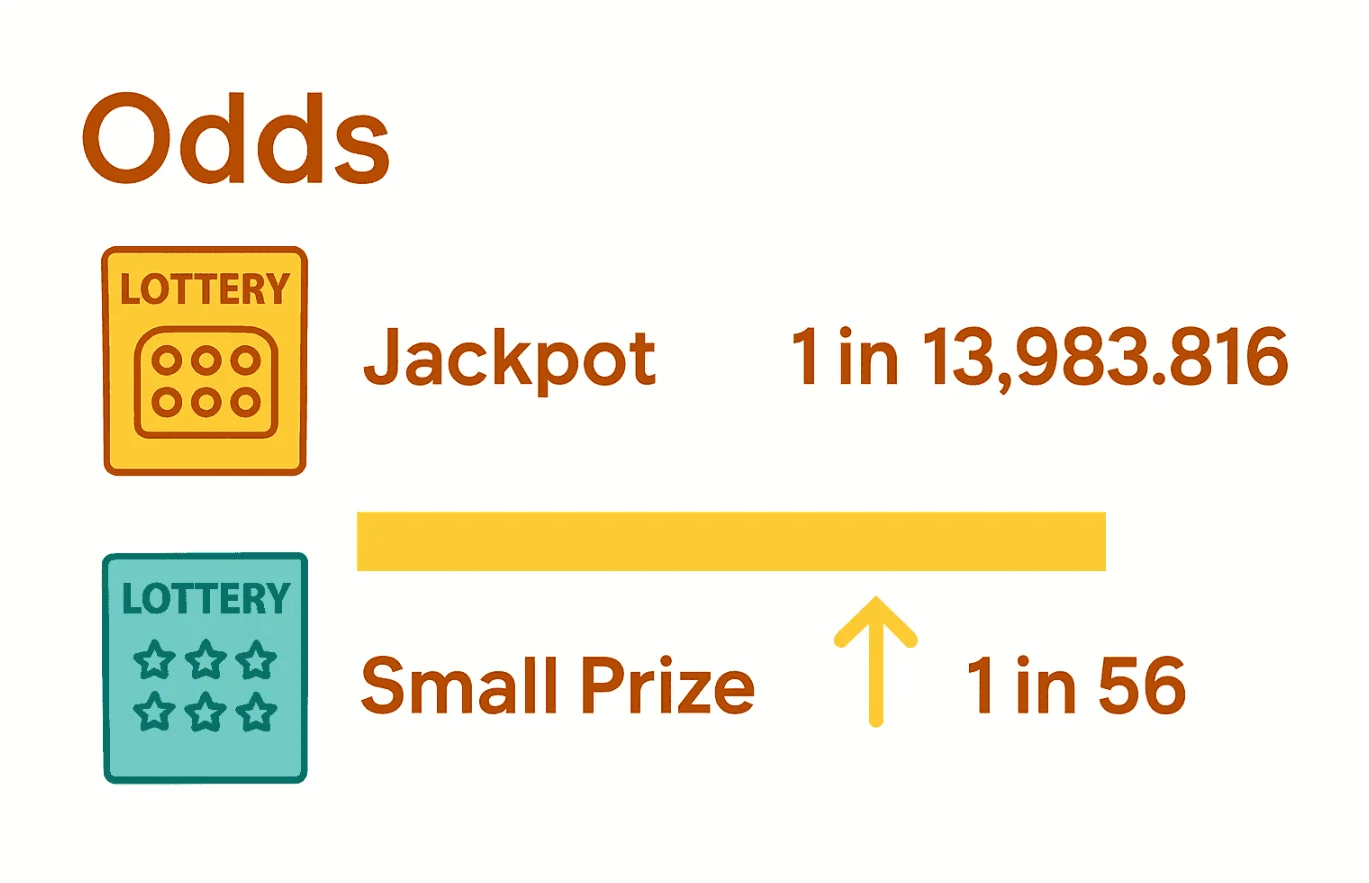
| Jackpot | 6/6 numbers | 1 in 13,983,816 |
| Second Prize | 5/6 + Bonus | 1 in 2,330,636 |
| Third Prize | 5/6 numbers | 1 in 55,492 |
| Fourth Prize | 4/6 numbers | 1 in 1,033 |
| Fifth Prize | 3/6 numbers | Approximately 1 in 56 |
Notice the dramatic shift in probabilities. While hitting the jackpot remains astronomically unlikely, your chances of winning smaller prizes are dramatically more realistic. For instance, in many lotteries, you have roughly a 1 in 50 chance of winning the lowest prize tier - a far cry from the millions-to-one jackpot odds.
The psychology of lottery play often fixates on the grand prize, but smart players recognize the value of consistent, smaller wins. These lower-tier prizes can provide modest but meaningful returns that offset your ticket costs over time.
Ready to analyze your own lottery strategy with precision? Explore our comprehensive prize tier simulator (Lotto 6/49) and discover how different number combinations impact your winning potential across various prize levels.
Smarter Lottery Strategies for Better Play
Lottery strategies are less about magical thinking and more about understanding mathematical probabilities. While no method can guarantee a win, certain approaches can help you play more intelligently and potentially maximize your chances of winning smaller prizes.
One powerful technique is the lottery wheeling system, a strategic method where players purchase multiple tickets covering various number combinations. Here’s how it works:
- Select a group of numbers larger than the typical game requirement
- Create multiple tickets that systematically cover different combinations of those numbers
- Increase your probability of winning lower-tier prizes if some winning numbers are drawn
However, it’s critical to understand the mathematical limitations. Buying more tickets marginally improves your odds but does not fundamentally change the astronomical improbability of winning. Some common misconceptions to avoid:
| Myth | Reality |
|---|---|
| Lucky Numbers | Every number has equal probability |
| Hot/Cold Numbers | Past draws do not influence future results |
| More Tickets = Better Odds | Odds increase minimally with more tickets |
Smart lottery play is about managing expectations and enjoying the game responsibly. Set a strict budget, never chase losses, and treat lottery tickets as entertainment rather than an investment strategy.
Want to develop a more systematic approach to your lottery play? Explore our advanced lottery wheeling strategies to understand how strategic ticket selection can optimize your potential winnings.
Transform Lottery Odds Into Your Advantage With LottoApex
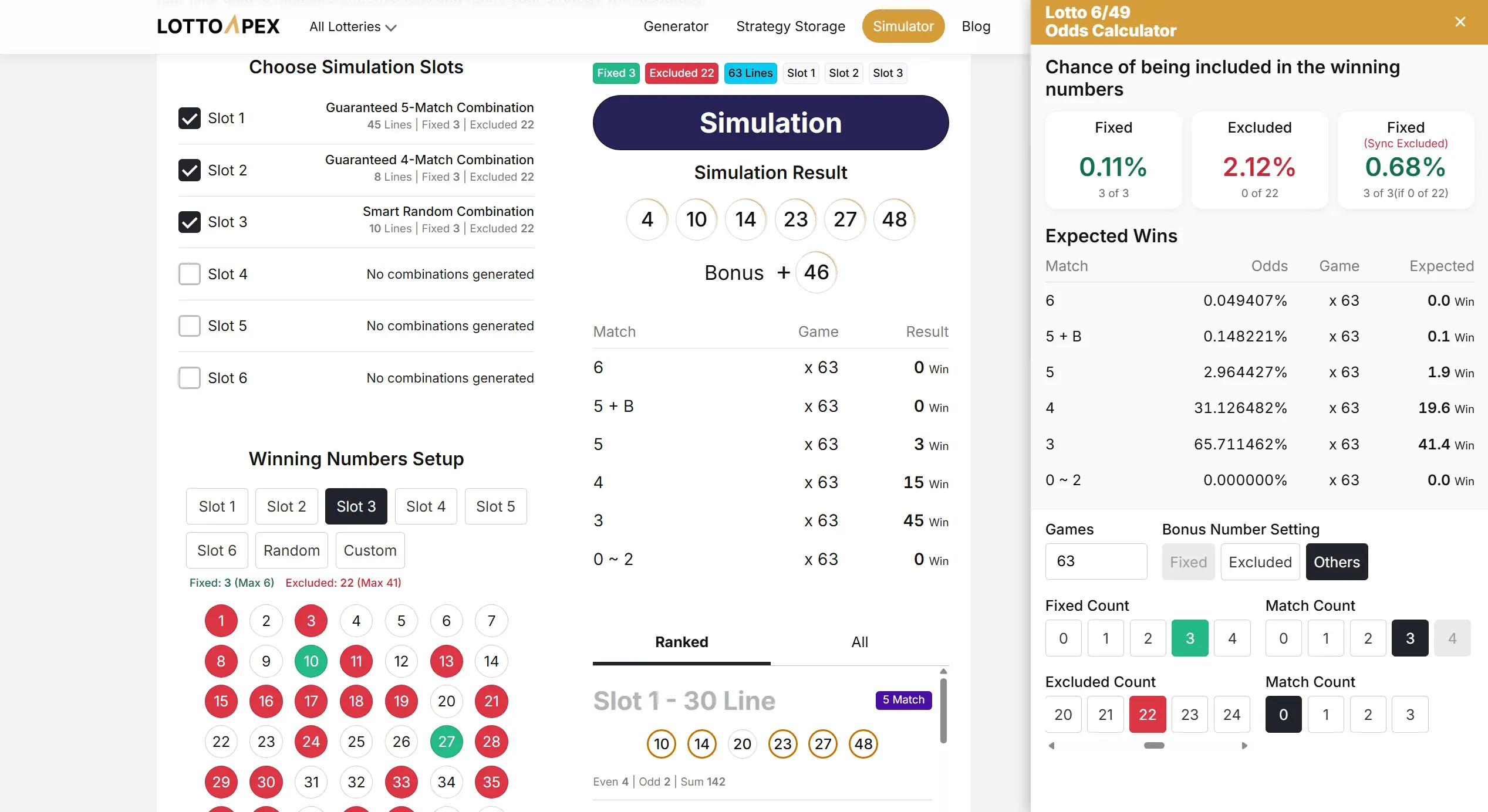
Winning the lottery has always been a mix of hope and numbers—but what if you could see the real math behind the game? The LottoApex Probability Calculator was built exactly for that purpose. Instead of guessing your chances, you can now calculate precise odds for every lottery format, from 6/45 to 5/69, and truly understand what each combination means. Whether you want to know the exact chance of matching 3, 4, or 5 numbers, or compare different ticket strategies side by side, the calculator transforms probability from a mystery into a clear and visual experience.
Once you’ve understood how odds work, it’s time to take that knowledge into action. This is where the LottoApex Number Generator comes in. Using advanced wheeling systems and AI-optimized quick pick, our generator lets you create multiple combinations that maximize coverage and minimize overlap — just like players do with popular lotteries such as Powerball, Mega Millions, or the Lotto 6/49 number generator. You can fix certain numbers you believe in, exclude numbers you want to avoid, and instantly generate statistically optimized sets ready for simulation.
After generating your strategy, the next step is validation. The LottoApex Simulator allows you to test your combinations against any set of winning numbers—real or hypothetical. Each simulation gives you detailed insights such as prize-tier match counts, hit ratios, and overall performance statistics. Instead of blindly hoping for luck, you can now see how your strategy performs over hundreds or even thousands of virtual draws.
Together, these three tools form a complete ecosystem:
- Odds Calculator → Understand real probabilities.
- Number Generator → Build smart combinations with logic, not luck.
- Simulator → Test and refine your strategies instantly.
This integrated loop—calculate → generate → simulate → optimize—turns what used to be pure chance into a measurable, repeatable process. With LottoApex, you can finally make data-driven decisions instead of guessing in the dark.
Stop leaving your lottery results to luck. Visit LottoApex today to explore the full suite of global lottery tools, powered by statistical modeling and designed for players who think differently.
Frequently Asked Questions
What are lottery odds based on?
Lottery odds are calculated using combinatorics and the probability of number combinations. The formula used is Odds = 1 / Total Possible Number Combinations.
How can I improve my chances of winning the lottery?
While buying multiple tickets can marginally improve your chances, it does not guarantee a win. Strategic methods like the lottery wheeling system can help cover more combinations without drastically increasing costs.
Are all lottery draws independent of each other?
Yes, each lottery draw is an independent event. Past draws do not influence future results, and every number combination has an equal chance of being selected.
What are typical odds for different lottery jackpot tiers?
Jackpot odds vary widely. For instance, hitting the jackpot in a standard 6/49 lottery is 1 in 13,983,816, whereas smaller prize tiers offer much better odds, such as 1 in 56 for matching at least 3 out of 6 numbers.