
Why Simulate Lottery Draws: Complete Guide for 2025

Every year, people spend over $300 billion worldwide on lottery tickets, fueled by the hope of beating the odds. This craving for a lucky break makes the science behind lottery draw simulation more fascinating than ever. Lottery simulations use powerful mathematical tools to break down what seems like total chance, uncovering real patterns and probabilities. Whether you are curious about winning strategies or want to see beyond pure luck, this approach offers clear insights into how numbers and randomness actually work.
Key Takeaways
| Point | Details |
|---|---|
| Monte Carlo Simulation | This method generates numerous random scenarios to estimate lottery probabilities and enhance understanding of outcomes. |
| Lottery Wheeling | A strategic approach that systematically covers number combinations to optimize winning potential while managing ticket costs. |
| Risk Management | Lottery simulations empower players to assess risk-to-reward ratios, allowing for informed decision-making and reduced financial exposure. |
| Common Pitfalls | Players must be aware of challenges such as insufficient sample sizes and reliance on low-quality random number generators that can distort simulation results. |
Table of Contents
- Core Concept Of Lottery Draw Simulation
- Different Types Of Lottery Simulations
- How Lottery Simulations Improve Strategy
- Real-World Applications For Lottery Players
- Common Pitfalls In Simulating Draws
Core Concept of Lottery Draw Simulation
Lottery draw simulation is a fascinating computational technique that transforms how we understand randomness and probability in games of chance. At its core, Monte Carlo methods power this approach, using advanced algorithms that generate thousands of simulated lottery draws to provide insights far beyond traditional guesswork.
Think of lottery draw simulation like running a massive digital experiment. Instead of waiting for actual draws, computational models repeatedly generate random number combinations, mimicking real lottery mechanics. These simulations track patterns, analyze distribution ranges, and estimate probabilities with remarkable precision. Stochastic simulation enables this process, where random inputs are continuously fed through a model to produce statistically significant outcomes.
What makes lottery draw simulation powerful are its key capabilities:
- Generating millions of potential number combinations
- Analyzing historical draw patterns
- Estimating probability distributions
- Identifying potential number sequences
- Providing data-driven insights without real-world financial risk
The mathematics behind these simulations are complex, but the goal is straightforward: transform unpredictable lottery draws into an analyzable dataset. By running repeated random sampling, statisticians and lottery enthusiasts can gain deeper understanding of potential outcomes, helping players make more informed number selection strategies.
Different Types of Lottery Simulations
Lottery simulations are not a one-size-fits-all approach. Different computational techniques offer unique perspectives on predicting and analyzing lottery outcomes. Probability modeling provides multiple strategies for understanding these complex games of chance, each with its own strengths and specific applications.
One prominent method is wheeling system simulation, a sophisticated approach where players systematically generate comprehensive number combinations. These simulations create intricate “wheels” that cover broader number ranges, strategically designed to increase the probability of winning specific prize tiers. By methodically mapping out potential combinations, players can assess ticket efficiency and potential win guarantees without spending real money.
Key types of lottery simulation strategies include:
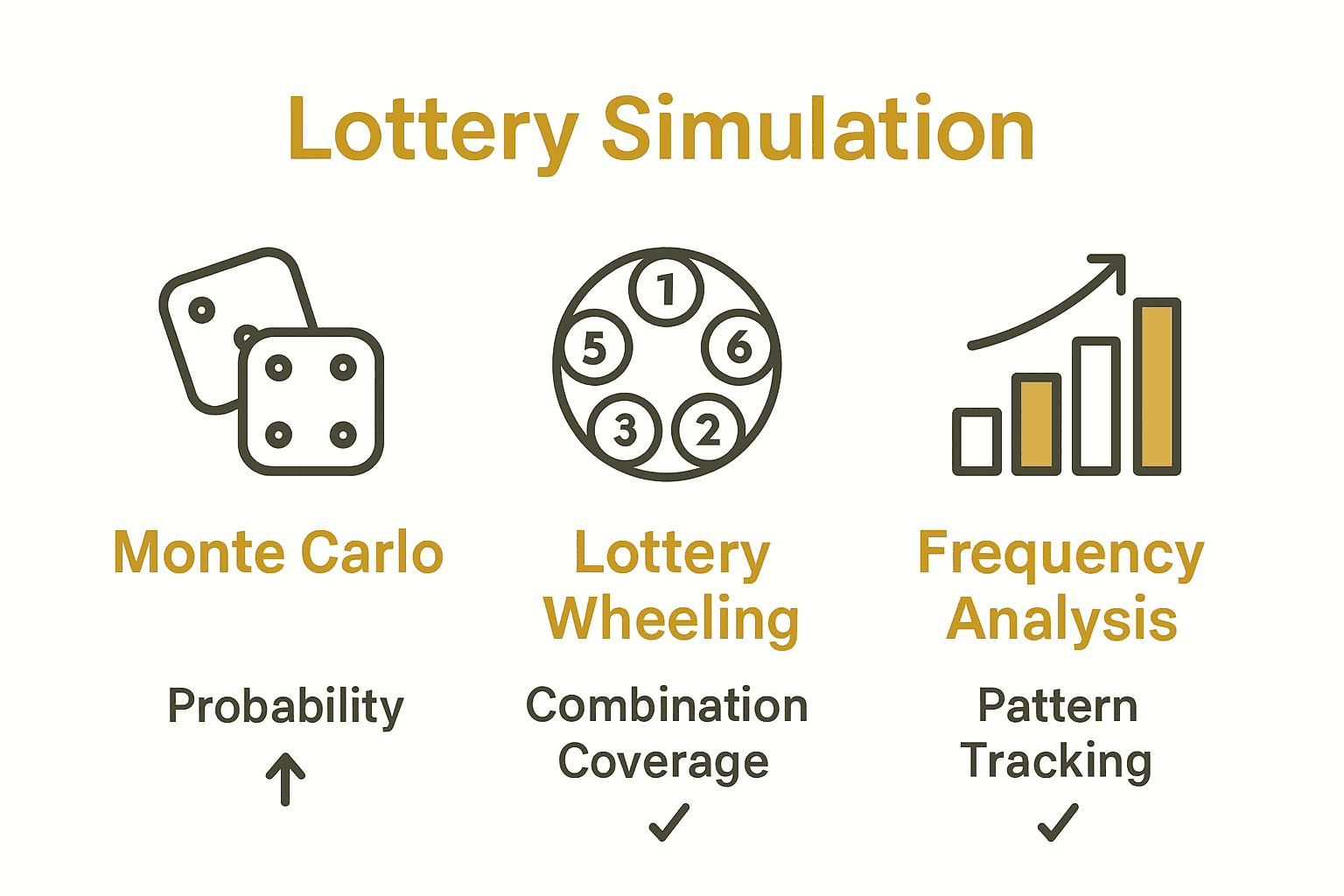
Here’s a comparison of major lottery simulation strategies:
| Simulation Type | Key Purpose | Typical Applications |
|---|---|---|
| Monte Carlo Simulation | Estimate probabilities Analyze randomness |
Predict draw odds Assess overall chance |
| Frequency Analysis | Track number patterns Analyze history |
Identify hot/cold numbers Pattern hunting |
| Lottery Wheeling | Systematic number covering Guarantee tiers |
Optimize ticket coverage Increase small-win chances |
| Probability Modeling | Calculate precise odds Map outcomes |
Select statistically balanced numbers Compare game types |
| Regression Simulation | Predict number trends Apply machine learning |
Model potential future draws Advanced forecasting |
- Monte Carlo Simulation: Generates millions of random draw scenarios to estimate statistical probabilities
- Frequency Analysis Simulation: Tracks historical number occurrence patterns
- Lottery Wheeling Simulation: Creates systematic combination sets with specific win guarantees
- Probability Distribution Modeling: Calculates precise odds and potential outcome ranges
- Statistical Regression Simulation: Uses machine learning techniques to predict potential number patterns
Advanced lottery simulations go beyond simple number generation. Projects like the Thailand government lottery simulation demonstrate how comprehensive these models can become. By incorporating actual prize structures, running thousands of simulated draws, and utilizing descriptive statistics, these computational approaches transform lottery analysis from guesswork into a data-driven exploration of probability and chance.
How Lottery Simulations Improve Strategy
Strategic lottery analysis transforms random chance into a calculated approach. By leveraging advanced computational techniques, players can move beyond blind luck and develop data-driven strategies that systematically improve their understanding of lottery mechanics. Simulations provide an unprecedented window into probability landscapes that were previously invisible to players.
Monte Carlo simulations offer remarkable strategic insights by running thousands of virtual lottery scenarios. These computational models reveal critical information like statistical ticket values, probable outcome distributions, and potential return ranges. Players gain a comprehensive view of their chances, helping them make informed decisions about number selection, ticket purchasing, and risk management without risking actual money.
Key strategic improvements from lottery simulations include:
- Identifying statistically optimal number selection approaches
- Understanding true probability distributions
- Evaluating ticket efficiency and potential returns
- Minimizing unnecessary financial risk
- Developing systematic number combination strategies
Wheel-based simulations take strategy even further by allowing players to test complex combination systems. By modeling different wheeling techniques, players can assess trade-offs between ticket coverage and potential win guarantees. This approach transforms lottery participation from a game of pure chance into a more calculated investment, where mathematical analysis provides a strategic edge in navigating probabilistic landscapes.

The LottoApex Simulator takes lottery analysis to a new level by allowing you to test every strategic combination built through the wheeling system. You can simulate countless scenarios — for example, adjust a fixed number to see how results shift, or include an excluded number in the winning draw to measure its impact. Every simulation offers deep insights into probability and pattern behavior, helping you refine your overall strategy with precision.
In addition, our integrated lottery odds calculator enables you to analyze every mathematical aspect of your play, from single-line odds to full system coverage. Predict potential results, validate them through real simulations, and evolve your strategy step by step into a more data-driven approach.
The simulator supports most global lottery formats — from 5-pick to 6-pick systems — giving you the flexibility to explore, test, and improve across multiple games, such as Powerball Simulator, Mega Millions Simulator, and Lotto 6/49 Simulator. Try it now and experience how a scientific, simulation-based approach can elevate your lottery play beyond random chance.
Real-World Applications for Lottery Players
Lottery simulations transform abstract mathematical concepts into practical tools that empower players to make smarter decisions. Practical probability analysis moves beyond mere guesswork, offering players sophisticated strategies for understanding and navigating lottery systems. These computational approaches provide real, actionable insights that can dramatically change how individuals approach lottery participation.
Syndicate strategy represents one of the most immediate applications of lottery simulations.
Practical applications of lottery simulations include:
- Developing group purchasing strategies for lottery syndicates
- Calculating precise risk-to-reward ratios for ticket investments
- Identifying statistically optimal number selection patterns
- Comparing potential returns across different lottery games
- Managing collective lottery participation budgets
Real-world examples, like the Thailand government lottery simulation project, demonstrate the tangible potential of these techniques. By incorporating actual prize structures and running thousands of simulated draws, players can transform lottery participation from a game of pure chance into a more calculated approach. These tools provide transparency, helping players understand the true mathematical landscape of their lottery investments.
Common Pitfalls in Simulating Draws
Lottery draw simulations are powerful tools, but they’re not infallible magic solutions. Many players fall into predictable traps that can compromise the reliability and effectiveness of their computational models. Understanding these potential pitfalls is crucial for developing accurate and meaningful lottery analysis strategies.
One of the most significant challenges in lottery simulations is achieving true randomness and statistical significance. Monte Carlo methods require massive numbers of computational runs to generate reliable estimates. Insufficient sample sizes can lead to dramatically skewed or misleading results. The quality of pseudorandom number generators becomes critical, as low-quality randomness can introduce systematic biases that invalidate entire simulation models.
Key simulation pitfalls include:
- Insufficient computational sample sizes
- Poor quality random number generation
- Overlooking computational complexity costs
- Misinterpreting probabilistic outcomes
- Assuming simulation guarantees actual results
- Failing to validate simulation methodologies
Commercial lottery wheeling systems present another potential minefield. Many products make mathematically questionable claims about guaranteed wins or improved odds. Players must critically evaluate these systems, recognizing that combinatorial complexity can quickly outpace practical benefits. The computational and ticket costs of elaborate wheeling strategies can easily exceed potential returns, transforming what seems like a strategic approach into an expensive exercise in statistical wishful thinking.
Ready to Experience Smarter Lottery Strategies in 2025?
Lottery simulations can move you beyond random guesses and help you make truly data-driven choices. If you have ever struggled with uncertainty, wasted money on ineffective systems, or wished you understood real probabilities as explained in this complete guide for 2025, you are not alone. With concepts like Monte Carlo methods, wheeling systems, and advanced probability analysis, discovering your best strategy is within reach.

Step forward and turn your lottery curiosity into confident action. Explore LottoApex and try out our powerful wheeling based lottery number generators, easy-to-use draw simulators, and expert odds calculators for top games like Powerball and EuroMillions. Discover what truly works for you today. Advanced tools and proven algorithms are just a click away so do not wait to upgrade your lottery strategy. Visit LottoApex today and start shaping your winning possibilities.
Frequently Asked Questions
What is lottery draw simulation?
Lottery draw simulation is a computational technique that uses methods like Monte Carlo simulation to generate thousands of random lottery draws, providing insights into randomness and probability.
How can lottery simulations improve my chances of winning?
Lottery simulations analyze patterns, estimate probabilities, and identify optimal number selections, helping players make informed decisions and improve their purchasing strategies without financial risk.
What are the different types of lottery simulation strategies?
Common types include Monte Carlo simulation, frequency analysis, lottery wheeling, probability modeling, and regression simulation, each offering different insights and methods for estimating outcomes.
What are the common pitfalls when simulating lottery draws?
Key pitfalls include insufficient sample sizes, poor random number generation quality, misinterpretation of probabilistic outcomes, and relying on commercial wheeling systems that make questionable claims about guaranteed wins.