
Lottery Odds Comparison: Complete Global Guide

Did you know that the chance of winning a typical 6/49 lottery is about 1 in 13.9 million? Many people dream of sudden riches, yet the math behind these games tells a different story. Understanding the true odds and probabilities can dispel common myths and help you make smarter choices before buying a ticket. A closer look at how lottery odds work unlocks surprising truths that separate random luck from real statistical chances.
Table of Contents
- Defining Lottery Odds And Probability
- Major Lottery Types And Odds Explained
- How Lottery Odds Are Calculated
- Data-Driven Tools For Odds Analysis
- Risks, Misconceptions, And Responsible Play
Key Takeaways
| Point | Details |
|---|---|
| Understanding Lottery Odds | Lottery odds reflect the probability of winning, with calculations based on possible winning combinations versus total outcomes. This variability changes with different game formats. |
| Variety in Lottery Types | Different lottery formats, such as single matrix and multi-matrix games, have diverse odds that can significantly affect winning probabilities. |
| Responsible Participation | Players should approach lotteries as a form of entertainment, understanding the low chances of winning and setting strict budget limits to minimize financial risk. |
| Data-Driven Decision Making | Utilizing advanced probabilistic analysis tools can enhance strategy and inform number selection, although no method guarantees a win. |
Defining Lottery Odds And Probability
Lottery odds represent the mathematical probability of winning a specific lottery game, calculated by determining the number of potential winning combinations against the total number of possible combinations. Probability is the likelihood of a particular outcome occurring, expressed as a fraction between zero and one, while odds represent the ratio of favorable outcomes to unfavorable outcomes.
To understand lottery odds, you need to grasp the fundamental calculation method. For instance, in a typical 6/49 lottery where players select six numbers from a pool of 49, the probability of matching all six numbers is incredibly low. Mathematically, this is calculated by dividing the number of ways you can win by the total number of possible number combinations. In this scenario, the odds might be approximately 1 in 13,983,816 - meaning you would need to play consistently for decades to have a reasonable chance of winning.
Interestingly, lottery odds vary dramatically across different game formats. Types of Lottery Odds Explained for Smart Players reveals that some lotteries have significantly more complex probability structures. These variations can include:
- Single matrix games (like 6/49)
- Multiple matrix games with additional bonus number selections
- Games with different prize tiers and corresponding odds
- Instant win games with predetermined winning probabilities
Professional lottery strategists understand that while the odds of winning the jackpot are extremely low, understanding these probabilities can help players make more informed decisions. Recognizing that each number combination has an equal chance of being drawn allows players to approach lottery participation more strategically, without falling into common misconception traps about “lucky” or “due” numbers.
Major Lottery Types And Odds Explained
Lottery games worldwide present a diverse landscape of game formats, each with unique odds and winning probabilities. National lotteries typically feature standardized matrix games where players select a set number of digits from a predefined range, with jackpot odds varying dramatically between different national systems. What Are the Odds of Winning the Lottery: Complete Guide highlights the significant variations in winning chances across global lottery platforms.
The most common lottery types include single-matrix games like 6/49 (where six numbers are drawn from 49), multi-matrix games with bonus numbers, and complex systems like EuroMillions and Powerball. These games differ substantially in their probability structures. For example, a typical 6/49 lottery offers approximately 1 in 13.9 million chances of hitting the jackpot, while more complex multi-matrix games might reduce winning odds to 1 in 292 million.
Understanding lottery types helps players make informed decisions about game selection. Different lottery formats present varying risk and reward profiles:
Here’s a comparison of major lottery types and their typical odds:
| Lottery Type | Format Example | Typical Jackpot Odds |
|---|---|---|
| Single Matrix | 6/49 | 1 in 13. |
 9 million |
| Multi-Matrix | Powerball
9 million |
| Multi-Matrix | Powerball
EuroMillions | 1 in 292 million |
| Instant Win | Scratch-offs | Varies
Often 1 in 3 to 1 in 5 |
| Syndicate | Group play options
Various formats | Depends on game
Higher chance per ticket pool |
- Single Matrix Lotteries: Simplest format with straightforward number selection
- Multi-Matrix Lotteries: Include additional number pools or bonus ball mechanisms
- Instant Win Games: Predetermined winning probabilities with immediate results
- Syndicate Lotteries: Group play options that increase collective winning potential
Professional lottery strategists recognize that while individual game odds are fixed, players can optimize their approach by understanding these structural differences.
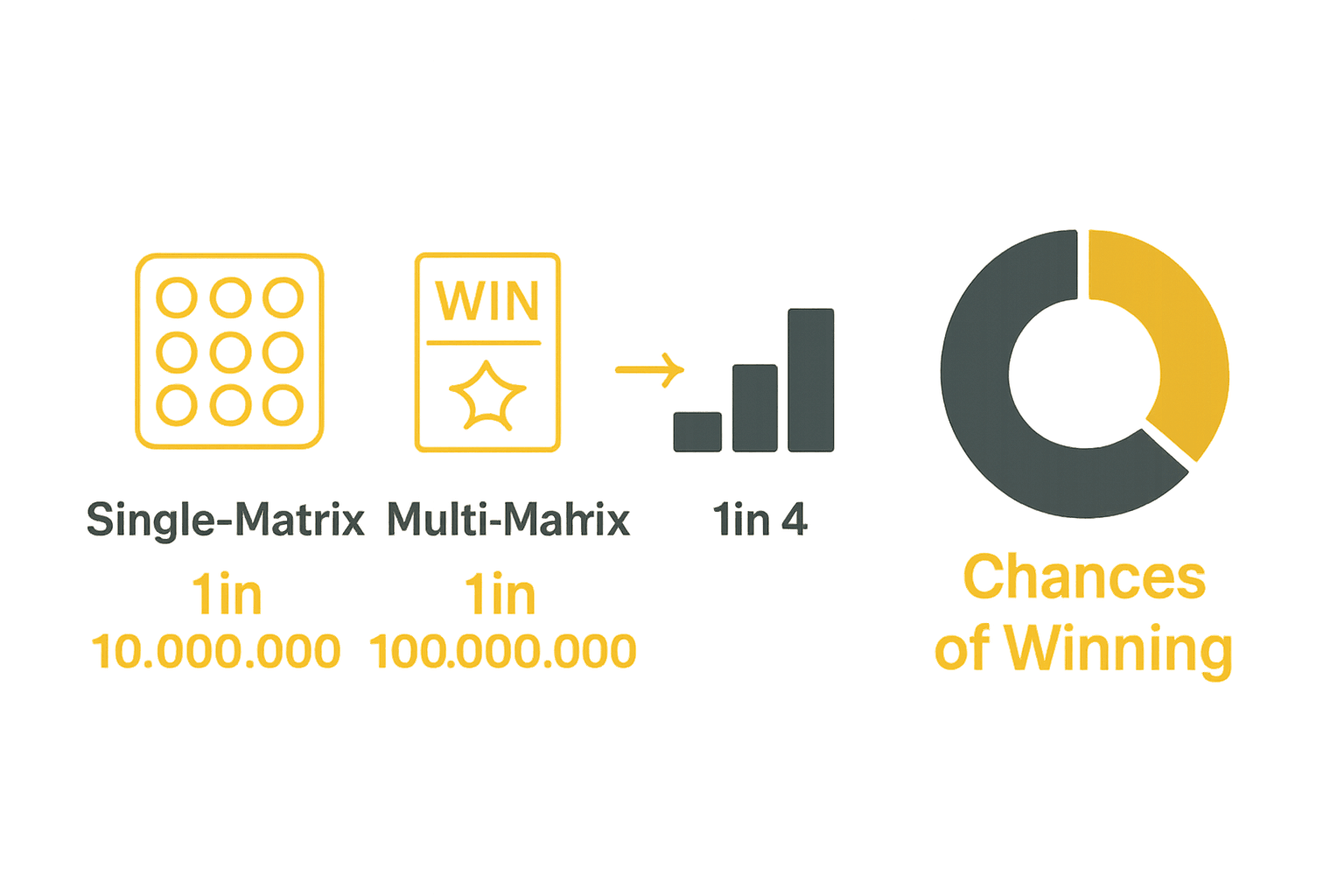 Intelligent participation involves analyzing each game’s specific probability landscape, recognizing that lower odds don’t necessarily mean impossible wins, but require realistic expectations and strategic play.
How Lottery Odds Are Calculated
Lottery odds calculation is a complex mathematical process rooted in combination probability, which determines the likelihood of specific number selections matching the drawn results. How to Calculate Lottery Odds for Any Game Easily explains the fundamental principles behind these intricate calculations, involving sophisticated mathematical formulas that transform raw number possibilities into precise winning probabilities.
The core calculation method involves using combinatorial mathematics, specifically the mathematical combination formula. For a standard 6/49 lottery, this means calculating how many unique ways six numbers can be selected from a pool of 49. The formula is represented as C(49,6), which translates to 49! / (6! * (49-6)!), resulting in approximately 13,983,816 possible number combinations. This means for every ticket purchased, a player has a 1 in 13,983,816 chance of hitting the jackpot - highlighting the incredibly slim odds of winning.
Professional lottery analysts utilize several key mathematical techniques to break down odds calculation:
- Combination Calculation: Determining total possible number arrangements
- Probability Multiplication: Assessing chances of specific number matches
- Independent Event Analysis: Understanding how each number selection impacts overall odds
- Permutation Techniques: Exploring different number sequence possibilities
The complexity of odds calculation varies dramatically across different lottery formats. Some games introduce additional complexity with bonus balls, multiple prize tiers, or variable number ranges, which require more nuanced mathematical approaches. Understanding these calculations helps players develop realistic expectations about their chances of winning, transforming lottery participation from blind hope to an informed statistical exercise.
Data-Driven Tools For Odds Analysis
Probabilistic analysis tools have revolutionized lottery strategy by transforming raw numerical data into sophisticated predictive models. Lottery Odds Calculation Workflow for Accurate Results demonstrates how modern computational techniques can provide players with unprecedented insights into winning probabilities, moving beyond traditional guesswork and intuition.
Advanced data-driven tools leverage complex algorithms that analyze historical drawing patterns, number frequency, and statistical distributions. These sophisticated systems go far beyond simple probability calculations, incorporating machine learning techniques that can identify subtle patterns in seemingly random number selections. For instance, some advanced tools can track number occurrence rates, cold and hot number trends, and generate predictive models that suggest statistically optimized number combinations.
Key features of modern lottery odds analysis tools include:
- Algorithmic Pattern Recognition: Identifying statistically significant number sequences
- Historical Data Mapping: Analyzing decades of past lottery results
- Probability Simulation: Running millions of virtual draws to estimate realistic outcomes
- Statistical Deviation Tracking: Measuring how actual results compare to theoretical probabilities
- Machine Learning Predictions: Generating number selection recommendations based on complex data models
Professional lottery analysts understand that while these tools cannot guarantee winning, they provide a scientific approach to number selection. By transforming lottery participation from pure chance to a data-informed strategy, players can make more intelligent decisions, understanding the intricate mathematical landscape that governs lottery outcomes.
Risks, Misconceptions, And Responsible Play
Understanding the psychological and financial risks associated with lottery participation is crucial for maintaining a healthy approach to gambling. Gambler’s fallacy represents one of the most dangerous mental traps, where players mistakenly believe that past drawing results influence future outcomes. Lottery Odds Calculation Workflow for Accurate Results highlights the importance of recognizing these cognitive biases that can lead to irrational decision-making and potentially harmful gambling behaviors.
Lottery misconceptions often stem from fundamental misunderstandings about probability and randomness. Many players develop false beliefs, such as thinking certain numbers are “due” to be drawn or that specific number combinations have higher winning potential. These misconceptions can drive compulsive behavior and unrealistic expectations. Statistical evidence consistently demonstrates that each lottery draw is an independent event, with every number combination having exactly the same probability of being selected, regardless of previous drawing results.
Key principles of responsible lottery participation include:
- Set Strict Budget Limits: Allocate a fixed, affordable amount for lottery play
- Recognize Entertainment Value: Treat lottery as entertainment, not a financial strategy
- Understand True Probabilities: Accept the extremely low chances of winning
- Avoid Chasing Losses: Never increase spending to recover previous investments
- Seek Help if Needed: Recognize signs of potential gambling addiction
Responsible players approach lotteries with a clear understanding that winning is exceptionally rare. The astronomical odds mean lottery participation should be viewed as a form of entertainment with a known, limited cost, rather than a legitimate financial investment or potential income source. Professional gambling counselors emphasize the importance of maintaining emotional distance and treating lottery tickets as a discretionary expense, much like purchasing movie tickets or other recreational activities.
Take Control of Your Lottery Strategy with Data-Driven Tools
Understanding the daunting odds of lotteries like Powerball or EuroMillions can feel overwhelming. The article reveals how complex combinations and probability calculations make winning a jackpot seem nearly impossible. You might be eager to move beyond guesswork and embrace intelligent approaches, like analyzing odds, wheeling systems, and using fixed-number strategies. Don’t let the low odds discourage you from playing smart and confidently.

Step up your game with LottoApex, a global lottery strategy platform designed to help you generate, simulate, and analyze numbers based on advanced probability algorithms. Unlock powerful tools like number generators and odds calculators tailored for popular games including Powerball and Lotto 6/49. Explore how lottery odds are calculated or compare global lottery odds to choose the best games for you. Don’t rely on luck alone—equip yourself with data-driven strategies today at LottoApex and start making every ticket count.
Frequently Asked Questions
What are lottery odds and how are they calculated?
Lottery odds represent the probability of winning a lottery game and are calculated by comparing the number of winning combinations to the total possible combinations. For example, in a 6/49 lottery, the odds are approximately 1 in 13,983,816, meaning that’s how many combinations exist for selecting six numbers from a pool of 49.
How do different lottery game formats affect winning odds?
Different lottery formats have varying odds due to their structure. Single matrix games, such as the 6/49 lottery, typically have better odds compared to multi-matrix games like Powerball or EuroMillions, which might present odds of 1 in 292 million, reflecting a more complex selection process.
What is the gambler’s fallacy in the context of lotteries?
The gambler’s fallacy is the misconception that past lottery results can influence future outcomes. Each lottery draw is independent, and all number combinations have the same probability, regardless of previous results. This can lead to irrational betting behavior.
How can data-driven tools assist in lottery odds analysis?
Data-driven tools use advanced algorithms to provide insights into winning probabilities and number patterns. They analyze historical data, simulate future draws, and help players make more informed decisions about number selection rather than relying solely on luck.