
Lottery Simulators Explained: Benefits, Types, and Use Cases

Did you know that millions of people use lottery simulators every year to test their luck and learn about randomness? For anyone curious about how the lottery really works, these tools offer a safe way to explore odds and patterns without risking any money. By showing how true randomness plays out over thousands of draws, simulators help uncover the truths behind winning numbers and decision-making in lottery games.
Key Takeaways
| Point | Details |
|---|---|
| Purpose of Lottery Simulators | Lottery simulators are designed to model random draws, helping users understand probability and the mechanics of lotteries. |
| Types of Simulators | They come in various forms, including statistical probability simulators, immersive game environments, and strategies testing platforms, each serving distinct analytical needs. |
| Operational Mechanics | By utilizing advanced random number generation, simulators provide statistically unbiased outcomes and insights into number behavior across multiple draws. |
| Cautions and Misconceptions | Users must recognize that simulators do not predict future outcomes, and should be approached as educational tools to enhance understanding of randomness and probability. |
Table of Contents
- Understanding Lottery Simulators And Their Purpose
- Types Of Lottery Simulators And Key Differences
- How Lottery Simulators Work Step By Step
- Popular Use Cases For Lottery Simulators
- Risks, Misconceptions, And Practical Tips
Understanding Lottery Simulators and Their Purpose
Lottery simulators are sophisticated digital tools designed to model random number draws with mathematical precision, providing players with powerful insights into probability and game mechanics. These advanced platforms use unbiased random number generators to replicate lottery drawing processes, allowing users to run thousands of simulated draws and analyze potential outcomes.
At their core, lottery simulators demonstrate fundamental statistical principles like the law of large numbers, which explains how frequencies of outcomes converge toward expected mathematical probabilities over high-volume trials. By generating multiple randomized scenarios, these tools help players understand that lottery results are genuinely unpredictable, with each draw remaining independent of previous outcomes. Learn more about lottery simulation techniques to grasp how randomness actually works.
Key features of lottery simulators include:
- Generating statistically accurate random number sequences
- Analyzing distribution patterns of even/odd numbers
- Tracking frequency of number ranges
- Providing visual representations of potential drawing scenarios
- Helping players understand probability without financial risk
These tools transform abstract mathematical concepts into practical, engaging experiences that demystify lottery mechanics. By running multiple simulations, players gain a deeper understanding of how randomness operates, which can help manage expectations and develop more rational approaches to lottery participation.
Types of Lottery Simulators and Key Differences
Lottery simulators come in diverse formats, each designed to address different analytical needs and player preferences. At their core, these tools can be broadly categorized into three primary types: statistical probability simulators, game environment simulators, and strategy testing platforms. Each variant offers unique features that cater to different aspects of lottery analysis and player engagement.
Here’s a comparison of the three main types of lottery simulators:
| Simulator Type | Main Focus | Typical Features |
|---|---|---|
| Statistical Probability | Mathematical modeling | Frequency analysis Pattern tracking |
| Game Environment | Realistic lottery experience | Customizable parameters Immersive draws |
| Strategy Testing | Testing number strategies | Strategy input Performance tracking |
Statistical probability simulators focus on pure mathematical modeling, generating thousands of randomized draws to demonstrate statistical principles. These tools help players understand underlying probability distributions and number frequency patterns. In contrast, game environment simulators create more immersive experiences, mimicking actual lottery drawing conditions with configurable parameters like game type, difficulty levels, and ticket variations.
Key differences between simulator types include:
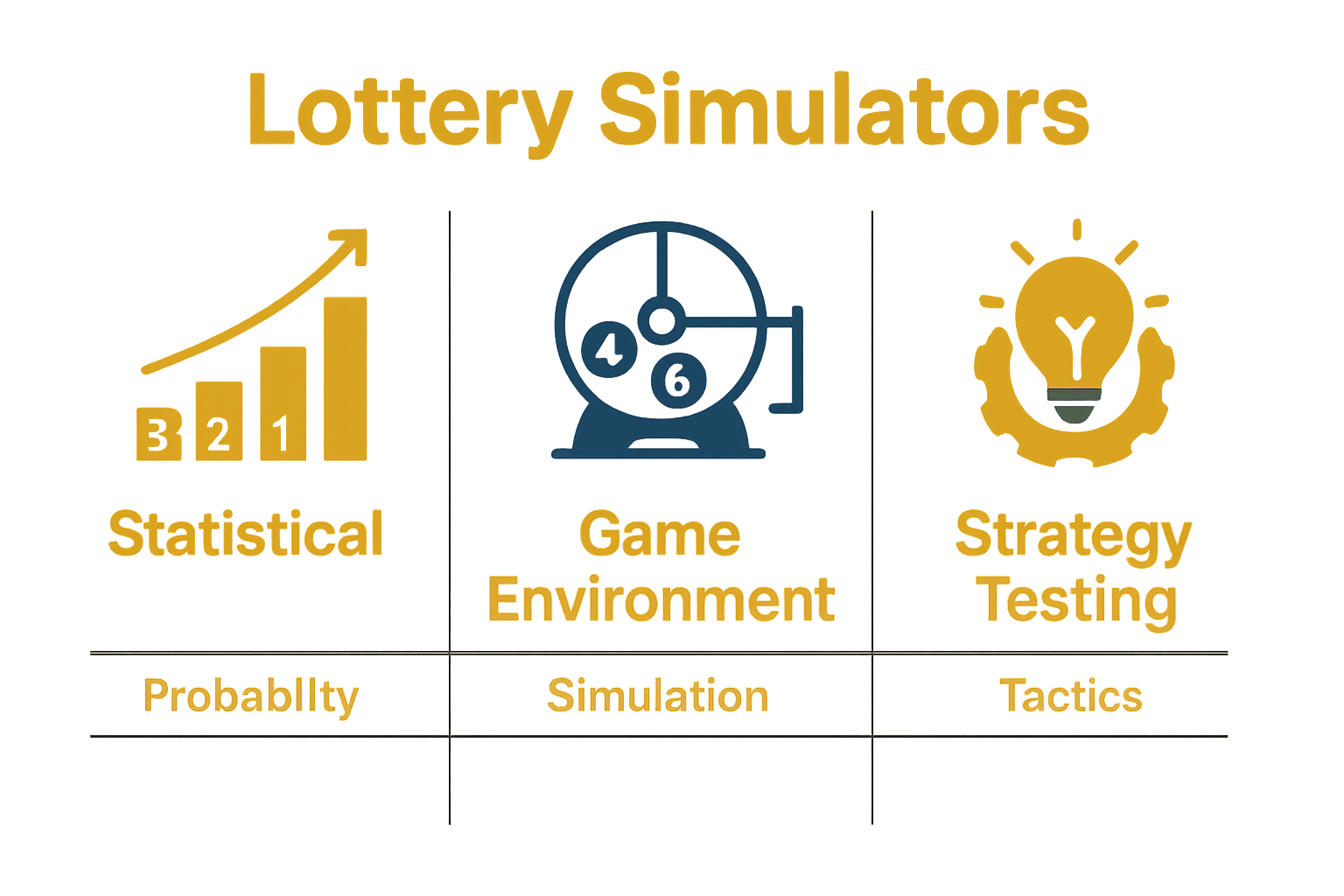
- Statistical Simulators: Pure mathematical modeling
- Game Environment Simulators: Immersive, near-realistic lottery experiences
- Strategy Testing Simulators: Allow players to test number selection strategies
Advanced simulators often blend multiple approaches, offering players sophisticated tools to explore lottery mechanics without financial risk. Whether you’re a data enthusiast interested in probability or a player seeking strategic insights, there’s a lottery simulator designed to meet your specific analytical needs.

How Lottery Simulators Work Step by Step
Lottery simulators operate through a sophisticated process of random number generation that mimics real-world lottery drawing mechanics. These digital tools use advanced algorithms to create statistically unbiased sequences that replicate the true randomness of lottery draws, ensuring each simulated outcome has an equal probability of occurring.
The core operational steps involve generating multiple randomized draws, tracking statistical patterns, and analyzing the resulting data. Explore how our Powerball simulator works to understand the intricate process of digital lottery modeling. Each simulation typically involves generating a complete set of numbers, recording their frequencies, and comparing the results against theoretical probability distributions to validate the randomness and accuracy of the model.
Key operational steps include:
- Initialize random number generator with fair probability settings
- Select specific lottery game parameters
- Generate multiple independent draw sequences
- Collect and analyze statistical outcomes
- Visualize number frequency and distribution patterns
- Compare simulated results with expected mathematical probabilities
The real power of lottery simulators lies in their ability to run thousands of draws instantaneously, providing players with insights that would be impossible to gather through manual tracking. By transforming complex probabilistic concepts into digestible visual representations, these tools help players develop a more rational understanding of lottery mechanics and random number behavior.
Popular Use Cases for Lottery Simulators
Lottery simulators serve multiple purposes beyond simple entertainment, offering players and enthusiasts sophisticated tools for understanding probabilistic systems. These advanced platforms provide users with opportunities to explore lottery mechanics, develop strategic insights, and gain a deeper comprehension of randomness without financial risk.
Educational applications represent a significant use case, as EuroMillions simulator platforms help users build intuitive understanding of complex probability concepts. By visualizing thousands of randomized draws, individuals can observe statistical patterns, rare sequence occurrences, and distribution behaviors that transform abstract mathematical principles into tangible, comprehensible experiences.
Key use cases for lottery simulators include:
- Developing probabilistic thinking skills
- Testing number selection strategies
- Understanding lottery game mechanics
- Entertainment without financial investment
- Analyzing statistical distributions
- Creating risk-free learning environments
Beyond academic and strategic applications, lottery simulators function as powerful psychological tools. They help players manage expectations by demonstrating the true randomness of lottery draws, reducing magical thinking, and providing a realistic framework for understanding gambling probabilities. Whether used for learning, strategy development, or pure entertainment, these simulators offer a unique window into the fascinating world of chance and mathematical prediction.
Risks, Misconceptions, and Practical Tips
Lottery simulators are powerful analytical tools, but they come with potential misunderstandings that can lead players astray if not approached critically. Many users mistakenly believe that simulator results predict future lottery outcomes or reveal guaranteed winning strategies, which fundamentally misrepresents the nature of true randomness and probability.
Understanding the limitations of these tools is crucial. Learn how to validate simulator accuracy by comparing observed distributions with theoretical probability expectations. Seeing unusual patterns or clustering in simulations is normal and does not indicate a predictive signal or underlying bias. The law of large numbers ensures that over thousands of trials, rare combinations will naturally appear, which doesn’t suggest any special meaning or future likelihood.
Practical tips for responsible simulator use include:
- Always remember simulators demonstrate probability, not predictions
- Analyze multiple simulation runs for consistent patterns
- Don’t interpret temporary streaks as meaningful trends
- Use simulators for education, not as guaranteed winning methods
- Verify the randomness of the number generation algorithm
- Maintain a critical and mathematical perspective
Ultimately, lottery simulators are educational tools designed to enhance understanding of randomness, not magical prediction machines. They offer insights into probability, help manage expectations, and provide a risk-free environment for exploring mathematical concepts. Responsible users approach these simulators as learning instruments, maintaining a clear distinction between simulation and actual lottery outcomes.
Unlock Real Lottery Insights With Data-Driven Simulation
Many players turn to lottery simulators to understand how randomness really works—but not all tools are created equal. Basic simulators can show random results, yet they rarely explain why certain number patterns appear or how probabilities behave over thousands of draws. This article explored how statistical models, strategy testing, and realistic simulation environments reveal the logic behind the lottery. Now it’s time to take that understanding further with LottoApex.
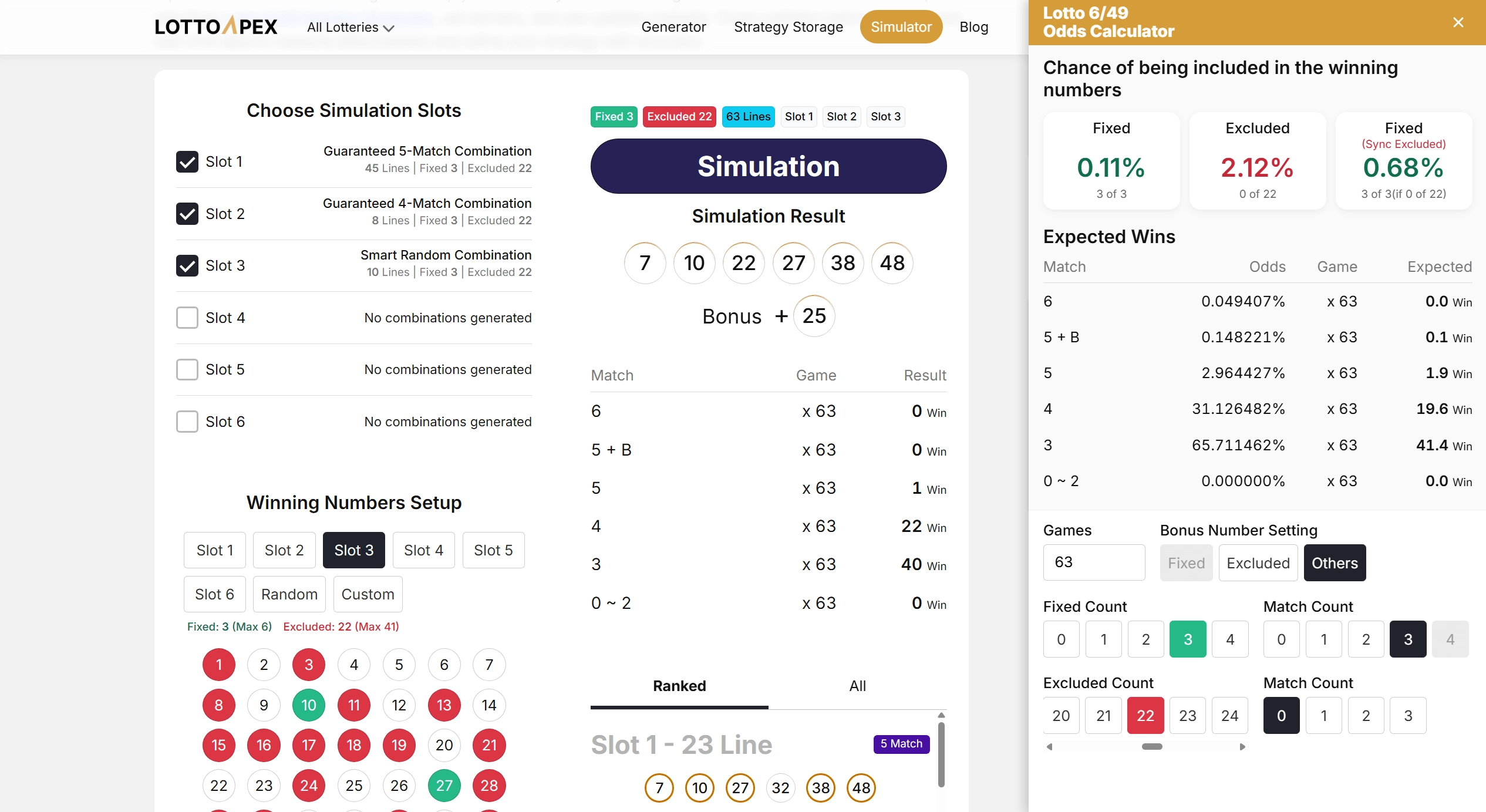
LottoApex offers a complete lottery simulator workspace that combines AI precision with true mathematical randomness. The Probability Calculator clarifies exact odds for every game, while the wheeling system-based Number Generator (Powerball) creates AI-optimized combinations (Lotto 6/49) ready for testing. Then, the interactive Simulator lets you run thousands of virtual draws, analyze hit ratios, and visualize statistical patterns across global lotteries like Powerball, EuroMillions, and Lotto 6/49 — all completely free and accessible worldwide.
Whether you’re experimenting with probability, verifying number performance, or comparing strategy outcomes, LottoApex helps you move beyond theory and see randomness in action. Experience a smarter way to simulate, calculate, and optimize — where every draw becomes a lesson in data-driven insight and strategic play, powered by free access and global lottery support.
Frequently Asked Questions
What is a lottery simulator?
Lottery simulators are digital tools designed to model random number draws in lotteries, using unbiased random number generators to replicate drawing processes. They provide insights into probabilities and game mechanics without financial risk.
How do lottery simulators work?
Lottery simulators use advanced algorithms to generate multiple randomized draws, tracking statistical patterns and analyzing the results. They mimic real-world lottery mechanics to help users understand randomness and probability distributions.
What are the different types of lottery simulators?
There are three main types of lottery simulators: statistical probability simulators, which focus on mathematical modeling; game environment simulators, which provide realistic lottery experiences; and strategy testing platforms, which allow users to test number selection strategies.
What are the benefits of using a lottery simulator?
Using a lottery simulator helps players develop probabilistic thinking skills, understand lottery game mechanics, test number strategies, and visualize statistical distributions, all in a risk-free environment designed for education and entertainment.