
Role of Simulation in Lotto Strategy: Complete Guide

Did you know that computers can generate and analyze over ten thousand virtual lottery draws in just seconds? With so much unpredictability in lottery games, many players are turning to advanced simulation methods to sharpen their strategies. These powerful techniques use cutting-edge mathematics to reveal patterns and probability insights that are nearly impossible to spot by hand, helping players approach the lottery with confidence and a smarter selection process.
Table of Contents
- Defining Simulation In Lotto Strategy
- Major Simulation Methods And Tools
- How Simulations Model Lottery Odds
- Real-World Use Cases For Simulations
- Risks, Limitations, And Common Pitfalls
Key Takeaways
| Point | Details |
|---|---|
| Lottery simulations optimize number selection | These simulations leverage advanced algorithms to analyze potential winning patterns, allowing players to make data-driven decisions. |
| Key simulation methods transform strategies | Techniques like Monte Carlo simulations and OCBA enhance strategic approaches to lottery number selection, testing multiple scenarios effectively. |
| Understanding limitations is crucial | Simulations cannot guarantee outcomes and may oversimplify complex probabilities; players should approach results with caution. |
| Real-world applications extend beyond gaming | Lottery simulations have valuable applications in policy allocation and consumer behavior analysis, showcasing their broader relevance. |
Defining Simulation in Lotto Strategy
A lottery simulation represents a strategic computational approach to modeling potential lottery draw outcomes using advanced mathematical algorithms. Unlike traditional guessing methods, simulations leverage complex statistical techniques to generate probabilistic scenarios that help players understand potential winning patterns and optimize their number selection strategies.
At its core, lottery simulation operates through agent-based computational economics (ACE), a sophisticated modeling technique that creates autonomous computational agents to simulate interactions and predict potential outcomes. These simulations generate thousands of hypothetical lottery draws, analyzing number combinations, frequency distributions, and probability scenarios that would be impossible to manually calculate.
The fundamental purpose of lottery simulations extends beyond mere random number generation. By employing lottery wheeling techniques and combinatorial mathematics, these computational models help players systematically analyze number selection strategies. Simulations allow users to:

- Test multiple number selection approaches
- Evaluate probability distributions
For those seeking deeper insights into lottery simulation techniques, our tutorial on lottery simulation strategies provides comprehensive guidance on leveraging these advanced computational methods effectively.
While simulations cannot guarantee winning, they transform lottery playing from pure chance to a more strategic, data-driven approach. By understanding potential patterns and probabilistic scenarios, players can make more informed decisions about their number selections and overall lottery strategy.
Major Simulation Methods and Tools
Lottery simulations employ several sophisticated computational methods to analyze and predict potential draw outcomes, ranging from basic probabilistic models to advanced statistical techniques. These methods transform random number selection into a strategic approach by leveraging complex mathematical algorithms and computational frameworks.
One prominent simulation technique is Optimal Computing Budget Allocation (OCBA), a powerful method designed to maximize the probability of selecting optimal number combinations while minimizing computational resources. OCBA allows lottery strategists to efficiently allocate computational power across different simulation scenarios, effectively testing multiple number selection strategies without exhausting system resources.
Another advanced approach involves the Datar–Mathews Method, which originally emerged from investment valuation but has been ingeniously adapted to lottery strategy simulation. This method enables players to assess potential returns and evaluate different number selection strategies through rigorous computational modeling. Key simulation methods include:
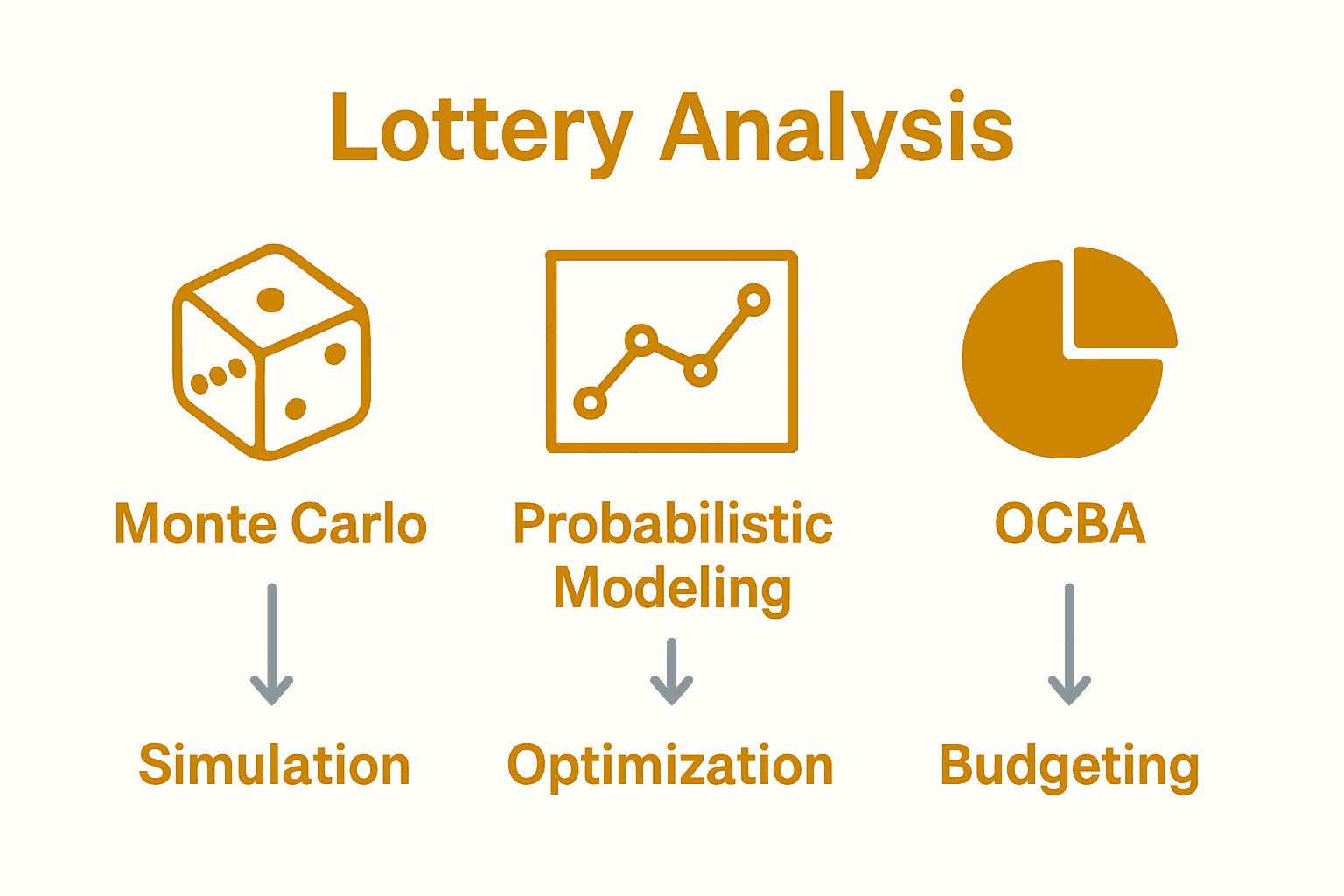
Here’s a comparison of major lottery simulation methods:
| Simulation Method | Key Features | Typical Use Cases |
|---|---|---|
| Monte Carlo Simulations | Random draw scenarios Probability analysis |
Predict number distribution Test strategies |
| Probabilistic Modeling | Number frequency patterns Distribution mapping |
Analyze draw trends Estimate win likelihood |
| Combinatorial Analysis | Complex combinations Systematic selection |
Optimize tickets Wheeling systems |
| OCBA (Budget Allocation) | Efficient resource use Focuses simulations |
Maximize optimal picks Reduce computation |
| Datar–Mathews Method | Return analysis Scenario evaluation |
Assess expected value Compare strategies |
- Monte Carlo Simulations: Generating thousands of random draw scenarios
- Probabilistic Modeling: Analyzing number frequency and distribution patterns
- Combinatorial Analysis: Evaluating complex number combination strategies
For players seeking comprehensive insights into these advanced simulation techniques, our guide on lottery simulation strategies provides an in-depth exploration of these computational approaches.
While no simulation method can guarantee lottery success, these tools offer players a data-driven framework for understanding probability, making more informed number selections, and approaching lottery participation with a strategic mindset. By leveraging sophisticated computational techniques, players can transform lottery participation from pure chance into a more analytical endeavor.
How Simulations Model Lottery Odds
Lottery odds modeling represents a sophisticated computational approach that transforms raw probability data into actionable insights through advanced simulation techniques. These models go beyond simple number-crunching, utilizing complex mathematical algorithms to deconstruct the intricate probabilistic landscape of lottery draws.
Recent research in behavioral economics has revolutionized lottery odds simulation, particularly through kinetic modeling approaches. By examining multiple interactions and agent-based behaviors, researchers can now create more nuanced representations of lottery probability. The groundbreaking studies, such as the ‘Multiple-interaction kinetic modelling of a virtual-item gambling economy’, demonstrate how computational models can simulate intricate decision-making processes that influence lottery participation and number selection strategies.
The simulation process involves several critical computational techniques:
- Probability Distribution Analysis: Mapping potential number combinations
- Behavioral Economic Modeling: Understanding player decision patterns
- Statistical Regression: Identifying potential number occurrence trends
- Monte Carlo Simulations: Generating thousands of hypothetical draw scenarios
Advanced simulation models, like those explored in the ‘Optimal design of lottery with cumulative prospect theory’ research, incorporate complex behavioral economics principles to understand how players make decisions. These models help players move beyond pure randomness and develop more strategic approaches to number selection.
For players looking to dive deeper into these sophisticated modeling techniques, our guide on lottery simulators provides comprehensive insights into how these computational approaches can transform lottery strategy. While simulations cannot predict exact outcomes, they offer a data-driven framework for understanding the complex probability landscape of lottery draws, empowering players with more informed decision-making tools.
Real-World Use Cases for Simulations
Lottery simulations extend far beyond simple number prediction, finding critical applications in diverse fields ranging from economic research to public policy implementation. These sophisticated computational models provide invaluable insights by analyzing complex decision-making processes and understanding probabilistic outcomes in real-world scenarios.
One compelling example emerges from academic research exploring state-run lottery dynamics. The groundbreaking study ‘What Drives Demand for State-Run Lotteries?’ leveraged advanced simulations to decode consumer behavior patterns, revealing intricate relationships between lottery design, participant motivations, and sales strategies. By modeling thousands of potential scenarios, researchers could unpack the nuanced factors influencing lottery participation more comprehensively than traditional analytical methods.
Interesting real-world simulation applications include:
- Policy Allocation: Modeling fair distribution mechanisms
- Consumer Behavior Analysis: Understanding purchasing decision patterns
- Risk Assessment: Evaluating potential economic and social impacts
- Strategic Planning: Informing lottery design and marketing strategies
Another fascinating case study comes from the Oregon Medicaid health experiment, which demonstrated how randomized selection—a core principle of lottery simulations—can be applied to critical social policy decisions. In this instance, a lottery system was used to allocate healthcare coverage, showcasing how simulation principles can be employed beyond traditional gambling contexts.
For players and researchers interested in exploring these sophisticated simulation techniques more deeply, our guide on lottery simulators offers comprehensive insights into the transformative potential of computational modeling. Simulations represent more than just a predictive tool—they are a powerful lens for understanding complex systems, revealing patterns and possibilities that traditional analysis might overlook.
Risks, Limitations, and Common Pitfalls
Lottery simulations, while powerful analytical tools, are not infallible predictive mechanisms. Players and researchers must approach these computational models with a critical understanding of their inherent limitations and potential risks, recognizing that sophisticated algorithms cannot guarantee absolute accuracy in predicting unpredictable lottery outcomes.
One significant challenge emerges from the Fuzzy Pay-Off Method, which highlights the critical risk of oversimplifying complex probabilistic systems. This research underscores the importance of acknowledging uncertainty within simulation models. Traditional valuation methods often fail to capture the nuanced randomness inherent in lottery draws, creating a false sense of predictability that can mislead players into believing they can definitively forecast winning numbers.
Common pitfalls in lottery simulation approaches include:
- Overconfidence Bias: Believing simulations can predict exact outcomes
- Data Limitation: Relying on insufficient or historical data
- Algorithmic Constraints: Failing to account for true randomness
- Computational Simplification: Reducing complex probability scenarios
Recent research, such as the study on ‘Using Reinforcement Learning to Validate Empirical Game-Theoretic Analysis’, emphasizes the critical need for empirical validation of theoretical models. This research reveals that simulation techniques must be continuously refined and cross-referenced with real-world data to maintain any semblance of predictive reliability.
For players seeking a balanced approach to understanding these computational challenges, our guide on lottery simulators provides comprehensive insights into navigating the complex landscape of probabilistic modeling. Ultimately, lottery simulations should be viewed as analytical tools for understanding probability patterns, not as guaranteed winning strategies.
Boost Your Lotto Strategy with Advanced Simulation Tools
The article highlights the power and complexity of lottery simulations in transforming pure chance into a strategic, data-driven game. If you are seeking to move beyond guesswork and master concepts like lottery wheeling, probabilistic modeling, and computational odds analysis you understand the challenge of applying these sophisticated methods on your own. Common pain points include managing vast simulation scenarios, understanding probability distributions, and avoiding overconfidence in results.
LottoApex offers a comprehensive solution designed exactly for players like you who want to simulate and analyze lottery numbers with precision. Our platform uses proven probability algorithms to generate number combinations, test wheeling systems, and simulate odds for popular lotteries including Powerball and Lotto 6/49. You can explore fixed-number analysis, exclusion numbers, and get an intuitive yet powerful resource that supports 8 languages.
Ready to turn simulation theory into winning practice?
Elevate your lottery strategy with LottoApex today and experience tools trusted worldwide.
Take control of your numbers with our cutting-edge lottery number generators and trusted lottery simulators. The deeper insights and data-driven approach will give you an edge that simple guesswork cannot match.
Start your journey to smarter lottery play now. Don’t leave your next draw to chance.

Frequently Asked Questions
What is lottery simulation and how does it work?
Lottery simulation is a computational approach to modeling potential lottery draw outcomes using mathematical algorithms. It generates numerous hypothetical lottery draws to analyze number patterns and probability distributions, helping players optimize their number selection strategies.
How can lottery simulations improve my chances of winning?
While lottery simulations cannot guarantee a win, they provide a data-driven framework to understand potential patterns and probabilistic scenarios. By analyzing past outcomes and testing various number selection methods, players can make more informed decisions.
What are the most common methods used in lottery simulations?
Common methods include Monte Carlo simulations, probabilistic modeling, combinatorial analysis, and Optimal Computing Budget Allocation (OCBA). Each method serves to analyze different aspects of lottery draws, such as number frequency and optimal strategy selection.
Are there limitations to using lottery simulations in my strategy?
Yes, lottery simulations have limitations. They cannot predict exact outcomes due to the inherent randomness of lottery draws and may oversimplify complex probabilistic systems. It’s essential to use simulations as tools for analysis rather than definitive predictors of winning numbers.